How much damage do fake shops cause? Existing estimates cover individual countries or networks. A calculation that brings the two together is still missing.
The scale became clear during our investigation of a fake-shop network we call DoppelCart. We started with individual fake shops we had reported for customers. Shared features in their source code and infrastructure led us to more shops, and we eventually linked 119,000 domains to the network. We were able to observe and analyse the largest publicly documented fake-shop network over several weeks. For this post, we analysed that data again: prices, reachability over time, registration dates, search tests and the time it took to have shops suspended.
In short: how much damage do fake shops cause?
- Per victim: $100 to $500 in losses per compromised card. DoppelCart captures card details and the bank confirmation code to add the card to a device controlled by the criminals.
- DoppelCart: Up to $216 million in annual losses is possible in our model. It uses around 90,000 DoppelCart shops active on October 12, 2026. The roughly 15,000 shops that had disappeared since early September are excluded.
- Worldwide: Our extrapolation gives $1.2 billion to $5.8 billion in annual losses across all fake shops worldwide, including those outside DoppelCart. Cross-checks using US and German data each give around $4 billion.
- Suspensions: nebty documented suspensions of reported DoppelCart shops one to five days after the report. The roughly 15,000 shops that disappeared between early September and October 12, 2026 account for up to $3 million in monthly losses in our scenarios.
The bait: $14 and 70% off
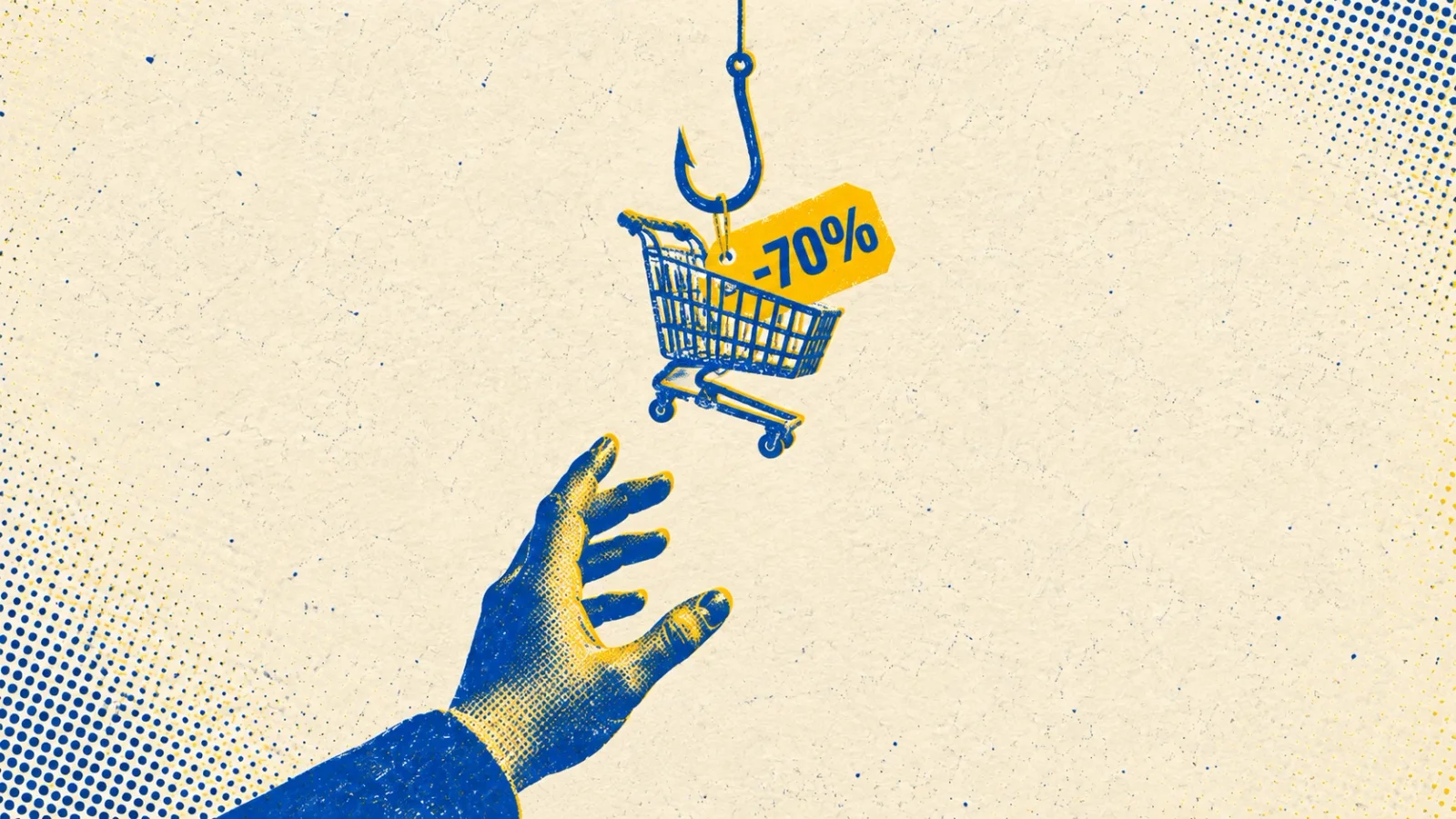
nebty examined saved pages from 80,428 DoppelCart shops and analysed 367,654 prices. Each of these shops displays crossed-out prices, and almost all apply a flat 65 or 70% discount. The median is $14, and 90% of prices are below $138. These prices for branded goods are unrealistic. The offers are intended to entice visitors to enter their card details.
The checkout is designed for this: it collects card details and the bank confirmation code. nebty documented this in its investigation, and BleepingComputer reported on it. DoppelCart does not need a merchant account with a payment provider for this. The order amount may never be charged. Losses can arise from the subsequent misuse of the card details.
How much damage does card fraud cause?
A nebty customer reported a case raised by a consumer with its support team: after she entered her card details in a DoppelCart shop, her card was added to a mobile payment service without her knowledge. This matches a method Krebs on Security described for phishing groups: the page asks for a bank confirmation code, and by entering it, victims actually approve adding their card to Apple Pay or Google Wallet on a phone the criminals control. From then on, the criminals pay with the card without the bank asking for another code. Security researcher Ford Merrill expects $100 to $500 in losses per card.
If a fake shop only takes the order amount, that is the loss: around $50 on average at BogusBazaar. The Finanzguru Fake Shop Report 2024 counted around 301,000 victims in Germany in 2023, with an average loss of €313 and more than €94 million in total.
Banks catch part of the card fraud: in the UK, they stopped 67p of every pound that fraudsters tried to take without consent in 2024, according to UK Finance. In the EU, banks generally have to refund what gets through. Even so, cardholders in the European Economic Area were left with around 38% of card fraud losses in 2024 (EBA and ECB), partly because banks argue gross negligence when someone entered the confirmation code themselves.
How much damage DoppelCart causes
nebty cannot directly measure how many people enter their credit card details in a DoppelCart shop. BogusBazaar provides a reference point: SRLabs documented more than one million orders across more than 75,000 domains in about three years, around 0.37 per domain per month. Our estimate is based on the following assumptions:
- Around 90,000 shops were still active on October 12, 2026. The model holds that number constant for a year.
- The model assumes 0.1 or 0.4 victims per shop per month.
- Each compromised card causes $100 or $500 in losses.
Our calculator lets you compare the four scenarios and change the assumptions yourself. The “All fake shops worldwide” switch opens an extrapolation for all fake shops, including those outside DoppelCart.
Explore the assumptions
Estimate the losses caused by DoppelCartEstimate losses across all fake shops worldwide
Choose one of the four scenarios from the article, or change the assumptions yourself.W1 and W2 apply the German victim rate and the DoppelCart loss per stolen card to all online shoppers worldwide. W3 and W4 cross-check with the average losses reported in the US and Germany. Choose a scenario or change the assumptions yourself.
Modelled annual lossesEstimated worldwide losses per year
$10.8M
108,000Victims per year
$900,000Losses per month
45×times first-year domain costs
0.9%DoppelCart share of modelled victims
Cumulative losses at a constant monthly rate. The blue line shows your selection. Four labelled grey lines show the article scenarios on the same scale.
Total up to month 12
- Your selection
- $10.8M
- Scenario S1:0.1 × $100
- $10.8M
- Scenario S2:0.1 × $500
- $54M
- Scenario S3:0.4 × $100
- $43.2M
- Scenario S4:0.4 × $500
- $216M
- Scenario W1:0.43% × $100
- $1.17B
- Scenario W2:0.43% × $500
- $5.83B
- Scenario W3:0.11% × $1,480
- $4.41B
- Scenario W4:0.43% × $340
- $3.96B
Hover over or tap the chart to see a single month. With keyboard focus, use the arrow keys; Escape goes back to the full year.
Root scale spreads out smaller amounts. Losses still increase by the same amount each month; the curved lines come from the scale.
shops × victims per shop per month × fraud loss per card × 12 monthsonline shoppers × victim rate × loss per victim
90,000 × 0.1 × 100 × 12 = $10,800,000
Illustrative model, not measured DoppelCart losses or operator revenue. The amounts are total fraud losses; banks and merchants bear part of them. Shop count and victim rate stay constant for 12 months. All amounts are USD; no currency conversion is implied.Estimate for all online shoppers worldwide. W1, W2: victim rate from Germany (Finanzguru, 2023), loss per card from DoppelCart. W3: rate and average loss from US online shopping fraud reports (FTC, 2024). W4: rate and average loss from Germany, converted at the ECB 2023 average. All amounts in USD.
DoppelCart · Modelled losses
$10.8M to $216M in losses per year
The fake-shop operators’ domain costs are low by comparison: 118,787 of the confirmed domains end in .shop, representing 2.72% of the .shop domain population we examined in September 2026. On September 29, 2026, Dynadot offered .shop domains for $1.99, and all of the roughly 8,500 domains with a public registration date were registered in 2025 or 2026. At about $2 per domain, first-year domain costs for the whole network come to around $240,000. This excludes software and hosting. The losses are 45 to 900 times as high.
Per shop, that is not much: in our scenarios, a single DoppelCart shop causes $10 to $200 in losses a month. A case before the Rostock Regional Court shows how much higher the losses per shop can be. There, just over 30 shops, each online for only days or weeks, found more than 10,000 victims and caused €4.34 million in losses (Händlerbund), more than 300 victims per shop. DoppelCart does not rely on yield but on volume: the network runs around 3,000 times as many shops.
Scaled up to all fake shops worldwide
To calculate worldwide losses, we start with the number of victims and use the loss per card from DoppelCart:
- 2.71 billion online shoppers worldwide (Statista, via Oberlo),
- 0.43% of them lose money to a fake shop each year, matching the rate among bank customers in Germany reported by Finanzguru,
- $100 or $500 in losses per victim, as with DoppelCart.
All fake shops worldwide · Extrapolation
$1.2B to $5.8B in losses per year
The results of two cross-checks fall in the middle of this range. With the average loss from Germany, €313 or around $340, it comes to nearly $4 billion. The US Federal Trade Commission received 383,441 reports of online shopping fraud in 2024, 76% of them with a loss of around $1,480 on average (Consumer Sentinel Data Book). That affects 0.11% of US adults; applied to all online shoppers, it comes to around $4.4 billion. Two independent data sets, around $4 billion in losses a year.
Switch the calculator to “All fake shops worldwide”
How many fake shops are behind these losses depends on how many victims a shop finds. If they all found as few as in our DoppelCart scenarios, it would take 2.4 million to 9.7 million simultaneously active shops. Published counts for 2026 show far fewer:
| Count | Size | Scope |
|---|---|---|
| Live in 2026 | ||
| DoppelCart · nebty, October 12, 2026 | around 90,000 active shops | worldwide |
| Fibergrid · Netcraft, April 2026 | 16,700 active shops | worldwide |
| FraudWear · CTM360, February 2026 | around 8,000 active at once | worldwide |
| Recorded over time | ||
| DoppelCart · nebty, 2025 to 2026 | 119,000 domains | worldwide |
| Fakeshop-Finder of the German consumer centres, since August 2022 | more than 100,000 shops | Germany |
| BogusBazaar · SRLabs, since 2021 | 75,000 domains | mainly Europe and the US |
| Netcraft block list, retrieved October 2026 | around 75,000 shops | worldwide |
| FraudWear · CTM360 | 30,000 domains | worldwide |
| Malwarebytes, March 2026 | 20,000 domains | worldwide |
How many shops appear on more than one list is not known. For 2026 this gives a range: if the live counts overlap completely, DoppelCart's 90,000 remain; if they do not overlap at all, it is around 115,000. There are two explanations for the gap between these counts and the estimate: there are far more fake shops than appear in published counts, or many shops find far more victims, as in the Rostock case. Most likely, both are true.
The additional harm to legitimate shops
Our extrapolation covers direct financial losses from fake-shop fraud and card misuse. After refunds, banks and merchants bear part of those losses. The economic consequences for legitimate shop owners extend further and are not included in our figures.
Reputational damage and customer service costs. Someone who orders from a copied shop and receives no goods may blame the real company. Complaints then reach the original shop’s support team. Its staff have to investigate orders from which the business earned nothing. Disappointed buyers may lose trust in the real brand. A 2021 Mimecast survey reported by Tech Monitor illustrates the stakes: 65% of UK respondents said they would stop spending with their favourite brand if they fell victim to a scam impersonating it.
Uncertainty can cost unrelated shops customers too. A study by the Austrian E-Commerce Trustmark describes how strongly shoppers favour providers they already know. A buyer who avoids unfamiliar stores out of fear of fake shops and chooses a familiar large platform instead is a lost customer for independent retailers. In our view, fake shops can therefore cost businesses sales even when their own stores have never been copied.
Additional competition increases marketing effort. We documented competition in search results for DoppelCart. For fake shops more broadly, the Federation of German Consumer Organisations also documents advertising on Google and Meta. Legitimate shops therefore compete with fraudulent offers for visibility. Additional competition in ad auctions can affect click prices. There is also the work of search engine optimisation to remain visible alongside fake shops in search results.
Lost sales, reputational damage and additional marketing costs increase the overall economic harm. Our DoppelCart data cannot quantify the combined value of these additional effects.
Why it pays off for the operators
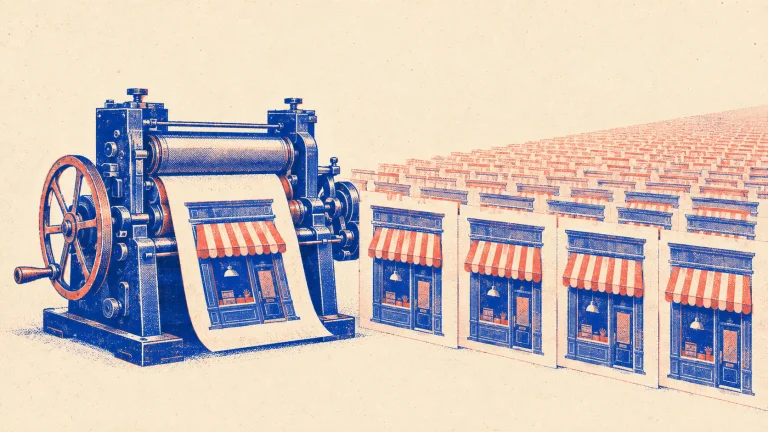
A new DoppelCart shop costs little more than its domain. 96% of the confirmed shops use identical build files. They are spread across 27 backend regions, averaging around 3,900 shops per region; at BogusBazaar, about 200 shops ran on one server, according to SRLabs. Product descriptions are copied word for word from real stores, and the fake shops load images directly from the affected brands' image servers. We extracted more than 44,000 brand labels from the shops.
DoppelCart also avoids two major costs of other campaigns. ERIAKOS, for example, used merchant accounts with payment providers, which can be shut down (Recorded Future); in 2025 alone, Recorded Future identified more than 3,600 fraudulent merchant accounts (Payment Fraud Report 2025). For ERIAKOS, Recorded Future also counted more than 100 Meta ads a day per site in many cases. For DoppelCart, we found no ad click identifiers. The shops get found anyway: in 22 of 26 searches for long product names copied verbatim, at least one DoppelCart shop appeared in the top ten results, mainly in a Bing-based search engine.
What suspensions achieve
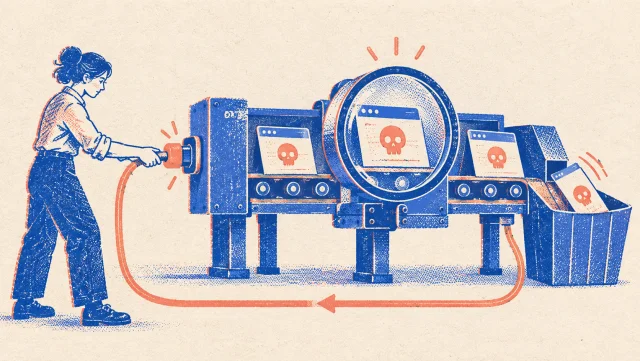
For DoppelCart shops that nebty reported and the registry subsequently suspended, one to five days passed between the report and the suspension. The operators keep replacements ready, though: for one brand, we found nine domains rather than the five initially known. Most of the network was still online on the last measurement date: more than 105,000 shops were active in early September 2026, around 90,000 on October 12.
The roughly 15,000 shops that disappeared between early September and October 12, 2026 account for $150,000 to $3 million in monthly losses in our scenarios. For affected brands, that means: do not just report the one shop you know about, but look for all copies and report the domains together. Our public DoppelCart database is one place to start. Our guide on how to remove a fake shop explains who can have a shop suspended and what a report needs to contain.
Until then, the complaints reach the real company: people ask about orders that were never placed with the real store. The guide's section on limiting the damage explains how to prepare customer service.
Frequently asked questions about fake shop losses
How much damage do fake shops cause worldwide?
By our estimate, $1.2 billion to $5.8 billion a year. It is based on 2.71 billion online shoppers, of whom around 0.43% lose money to a fake shop each year according to Finanzguru data from Germany, and $100 to $500 in losses per stolen card from our DoppelCart analysis. With the average losses from the US or from Germany, it comes to around $4 billion.
How much damage do fake shops cause in Germany?
The Finanzguru Fake Shop Report 2024 estimates that around 301,000 people in Germany fell for fake shops in 2023. Losses exceeded €94 million, about €313 per victim on average.
How much damage does DoppelCart cause?
Up to $216 million in annual losses in our model, based on around 90,000 active shops counted on October 12, 2026. The four scenarios give $10.8 million to $216 million, depending on the assumed victim rate and loss per card.
How much does each victim lose?
If a fake shop only takes the order amount, that is the loss: around $50 on average at BogusBazaar, €313 in Germany according to Finanzguru. When a shop captures card details and the bank confirmation code, as DoppelCart does, each card taken over means $100 to $500 in losses.
Who pays when a fake shop leads to card fraud?
In the EU, banks generally have to refund charges the cardholder did not authorise. Even so, cardholders in the European Economic Area bore around 38% of card fraud losses in 2024, according to the EBA and ECB. If a cardholder entered the confirmation code themselves, the bank may argue gross negligence.
What damage do the copied companies suffer?
Legitimate shops face reputational damage, customer service costs and potentially lost sales when uncertain buyers move to familiar large platforms. They also face additional marketing work from competing with fake shops in ads and search results. These effects are not included in our extrapolation of direct fraud losses; we have not quantified their combined value.
What does a fake shop cost its operators?
Very little: a .shop domain costs about $2 in the first year, and software and content are reused across thousands of shops. For the whole DoppelCart network, first-year domain costs come to about $240,000. The victims’ losses are 45 to 900 times that.
Further reading: the DoppelCart investigation and how to remove a fake shop.